The total number of electric vehicles on the road worldwide is increasing at pace.
And, for all the environmental benefits that this EV adoption surge brings, it also presents serious challenges when it comes to charging.
How can we ensure adequate access to power for a rapidly growing EV fleet? The role of EVs in reducing carbon emissions could all be for nothing if a surge in charging causes strain on grids and increased use of fossil fuels.
Fortunately, energy storage can help. Energy storage offers solutions for reducing the potential strain on grids – from home battery storage systems, to EVs potentially exporting energy back to the grid.
Here, we explore the intersection of electric vehicles and energy storage.
📈 The (necessary) rise of electric vehicles
As the world heads towards net-zero carbon emissions, the positive role of electric vehicles – including fully electric and plug-in hybrid electric vehicles – is becoming increasingly clear.
According to Massachusetts Institute of Technology (MIT), EVs create fewer carbon emissions over their lifetime than cars with internal combustion engines (ICEs). That’s despite the carbon-intensive manufacturing process of creating lithium-ion batteries that power EVs.
Further research shows that EVs are essential to achieving net-zero. According to the International Energy Agency (IEA), the share of EVs in total motor vehicle sales will have to reach approximately 60% by 2030, if the world is to reach net-zero carbon emissions by 2050.
Though the pace of growth in global EV sales has slowed – from 60% in 2022 to 31% in 2023 – steady growth of between 25-30% is forecast for 2024.
So, we need EVs. We know that they pay off. But do we have the infrastructure to ensure adequate access to charging?
🔌 The challenge of charging EVs
While it’s acknowledged that EVs are more eco-friendly than ICE vehicles overall, this is not to downplay the challenges facing existing electricity grids when it comes to charging EVs.
The problem is two-fold.
1️⃣ Firstly, there’s the question of whether the grid can handle the demand for EV charging.
2️⃣ Secondly, there’s the question of whether the electricity used to power EVs can come from sustainable energy sources. After all, burning more fossil fuels for the purpose of charging would be counterproductive.
In the USA
This charging challenge is already a hot topic in the United States. (Where, for an idea of scale, it is expected that more than half of cars sold by 2030 will be EVs.)
According to a policy project from Princeton University, light-duty vehicles are projected to use up to 3,360% more electricity by 2035 compared with today.
EVs will only be an effective means towards net-zero if the growth in electricity demand is matched by necessary infrastructure upgrades.
To make this happen, the following is required:
- More high-voltage transmission lines to transport electricity from wind and solar plants
- Smaller distribution lines and transformers for last-mile electricity delivery
- Hardware such as inverters that allow customers with home batteries, EVs and solar panels to feed excess electricity back to the grid
In the EU
A similar problem has arisen in European Union countries.
The European Commission has unveiled plans to upgrade grids, including addressing EV charging station power shortages. (A problem that campaign group ChargeUp Europe says is intermittent.)
Even though only 5.4% of passenger cars in EU member states run on alternative fuel – including fully electric vehicles – the installation of more charging points has created “bottlenecks for power companies”.
A European Commission spokesperson told Reuters that the time needed for connecting charging points to the grid was a “barrier” to expansion.
A shining example from Norway
When it comes to clean and effective charging of EVs from the grid, Norway stands out as an example. Around two-thirds of new passenger vehicles sold in the country were electric in 2021. (Thanks, in large part, to generous tax incentives.)
As Norway gets most of its energy from hydropower, its EVs have a largely negligible carbon footprint when it comes to charging. This provides a prime example of how EVs can be charged sustainably from the grid.

🔋 The emergence of storage technology as a route to energy independence
The notion of households and businesses being energy independent would have seemed farfetched not so long ago. However, it is increasingly becoming a reality for many.
In many cases, energy independence is achieved through the practical and scalable option of solar panels.
Take the UK as an example. Here, around 1.3 million homes now have solar panels. However, installations of complementary energy storage systems, or home batteries, are lagging somewhat. Figures from 2019 show that just 10,000 UK homes had installed home batteries. (Though this figure has of course grown since then.)
Unbeknownst to many, renewable technology – solar panels, home wind turbines, etc. – don’t work so well without battery storage. That’s because renewables tend to have hour-to-hour variability. You can’t simply turn the sun and wind on and off whenever you like. Instead, you need to store the energy generated for later use, such as during peak hours.
For those without the means to install renewable technology – financial, practical, or otherwise – standalone battery storage can also bring benefits to the grid. If users charge during off-peak hours and discharge during peak hours, this helps to reduce strain on the grid when energy is most in demand.
And, importantly, energy storage also has a crucial role to play in sustainable EV charging.
⚡️ How energy storage can support sustainable EV charging and reduce strain on the grid
When it comes to sustainable EV charging, energy storage, including home batteries, offers huge potential.
Smart EV chargers can be integrated with home battery systems to ensure vehicles are charged as efficiently and sustainably as possible.
This could be when excess renewable energy is being generated, or when abundant energy is stored within a battery system, for example. In short, smart EV chargers minimise the impact on the grid.
Research by the UK government suggests that EV users are gradually taking up smart charging at home. In its survey, the Department for Transport found that:
- 93% of respondents said they had access to home charging
- 52% used a smart charger, 75% of which used the smart function almost all the time
Other studies suggest similar growth.
- According to the IEA, around 89% of EV chargers are installed in private locations. (E.g., homes and offices.)
- Meanwhile, according to Statista, the EV private charger market was worth 7.07 billion USD in 2021. It’s projected to grow to an impressive 26.64 billion by 2026.
This uptick in smart charging at home is a key tenet in ensuring the sustainability of EVs. Indeed, a highcase study from a Danish household– equipped with a battery storage system, and solar PV panels – highlights significant benefits of smart charging. The year-long study found that charging a 62kWh Nissan Leaf when there was excess solar energy increased self-consumption (non-reliance on the grid) from 29-54%. Charging from an 8kWh battery storage system yielded similar results.
With EV charging at home and work only set to increase, the crucial role of energy storage and renewable technology in households and businesses becomes ever clearer.
💡 How EV batteries could act as energy storage
The idea of vehicle-to-grid (V2G) charging is still in its infancy. However, some evidence has already shown its potential to reduce strain on the grid.
Researchers from MIT found that V2G charging – energy being exported from EV batteries to the grid – could help to balance the intermittency of wind and solar. Total system savings resulting from V2G charging in the researchers’ simulation amounted to 183-1,326 million USD.
Similarly, the UK government has noted the positive role that bidirectional charging functions in EVs could play in powering homes. (I.e., electricity going from EV batteries to power household devices.) This would bring benefits to households and businesses by reducing energy bills, as well as helping to stabilise the grid under strain.
To that end, the government has allocated 4.8 million pounds in funding to four projects researching the potential of bidirectional charging.
EV batteries acting as energy storage might not yet be a reality for most EV users. As bidirectional charging technology develops, the potential for reducing strain on the grid will likely become clearer.
💫 Towards sustainable mobility
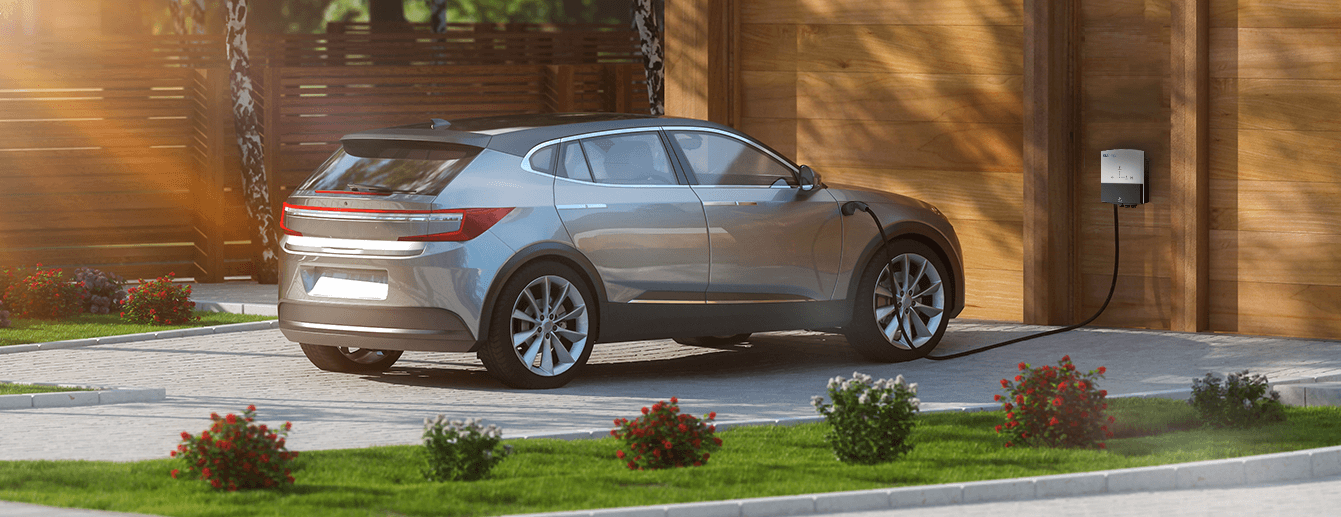
The role of electric vehicles in achieving net-zero carbon emissions is clear.
However, it’s also clear that these power-hungry EVs must be charged sustainably. A surge in EV charging leading to strained electricity grids and the increased burning of fossil fuels would be counterproductive to achieving net-zero aims.
The challenges of charging EVs – particularly charging in private locations (households, businesses, etc.) – can be addressed through:
- Battery storage
- Renewable technology
- Smart EV chargers
Moreover, bidirectional charging technology could even mean that EV batteries act as energy storage systems. We could soon see a future where EVs export energy to the grid, with their stored clean energy used by households for everyday electricity needs.
So, the intersection of EVs and energy storage will help unlock truly sustainable mobility in line with net-zero targets.