Hydrogen heating is gradually emerging as an alternative to natural gas in the UK.
As the UK heads towards net zero carbon emissions, heat decarbonisation has become a necessity. Around 85% of Britain’s 30 million still use carbon-emitting natural gas for heating.
However, much like hydrogen cars, hydrogen heating is yet to go mainstream in the UK.

Here, we explore the pros and cons of hydrogen heating, whether it will be deployed at scale, and a viable zero carbon alternative.
What is hydrogen heating?
Put simply, a hydrogen heating system involves the burning of hydrogen to generate heat.
So, instead of a gas boiler burning natural gas and emitting carbon, you’d have a hydrogen boiler burning hydrogen.
One of the biggest advantages?
Unlike a gas boiler, there are no direct carbon emissions from burning hydrogen.
Pros of hydrogen heating
1. ‘Green’ hydrogen
Generating carbon free hydrogen is possible through electrolysis powered by clean energy, such as solar or wind.
This ‘green’ hydrogen could then be supplied to homes and businesses for heating.
This means that through the entire process – from generation to burning for the use of heating – green hydrogen has produced zero carbon emissions.
An option for decarbonising heat and in turn, helping to achieve net zero by 2050.
2. Repurposing the pipes
According to National Grid, hydrogen could be transported to homes and businesses through the existing gas networks.

In other words, a lot of existing infrastructure could be repurposed as a net zero alternative.
Of course, this would have to be paired with other technology, notably hydrogen boilers.
Cons of hydrogen heating
1. Not all hydrogen is green
Whether or not hydrogen is completely carbon free depends on how it’s generated.
In fact, according to one peer-reviewed study, most hydrogen is ‘grey’, meaning the process used to generate it results in carbon emissions.
In between ‘grey’ and ‘green’ sits ‘blue’ carbon. This involves using carbon capture and storage technology to limit carbon emissions.
However, according to the same peer-reviewed study, there’s little evidence that ‘blue’ carbon is anywhere close to being carbon free.
The study found that ‘blue’ carbon results in the release of “fugitive methane”. That’s due to the increased use of natural gas to power the carbon capture technology.
According to estimates, ‘blue’ hydrogen results in the emission of around 9-12% less carbon dioxide than ‘grey’ carbon.
That’s 9-12% in the right direction but nowhere near enough to achieve net zero.
Unfortunately, 100% renewable hydrogen is around 2-3 times more expensive to produce compared with energy from fossil fuels, according to the International Renewable Energy Agency (IRENA).
2. Infrastructure
As National Grid acknowledges, hydrogen boilers exist but are not yet widespread.
That will have to change if hydrogen heating is to be deployed at scale.
There’s also the issue of getting the hydrogen to where it needs to be, i.e. to the homes, businesses, and other buildings which need heating.
Repurposing the gas network may be an option. However, there are still a few unknowns.
For example, hydrogen travels at different speeds to natural gas.
To investigate this and other differences, experiments in hydrogen blending are under way. As suggested by the name, these involve blending hydrogen and natural gas to supply heating to buildings.
It’s estimated that hydrogen blending on a national scale could have the equivalent effect of taking two million cars off the road annually.
Another step in the right direction but not quite zero carbon.
So, will hydrogen heating take off in the UK?
Short answer: probably not for some time yet.
On the one hand…
… there are signs that government and industry are taking hydrogen seriously as a long term carbon free heating solution.
The Department for Energy Security & Net Zero (DESNZ) acknowledges that there “could be some good reasons to use hydrogen”. These include the aforementioned advantages of repurposing the existing gas network, as well as the replacement of gas boilers with like-for-like hydrogen boilers.
In the Scottish county of Fife, the H100 Fife project is a first of its kind seeking to supply 100% renewable hydrogen for the purposes of heating and cooking.

Fife Council is working in collaboration with gas distribution company, SGN. DESNZ notes that the trial will help inform future policy on hydrogen heating.
The project is said to be proceeding well, though there are some supply chain and procurement challenges which have delayed the project launch until 2025.
Moreover, back in October 2023, the government – along with industry body, Energy and Utilities Alliance (EUA) – backed the further deployment of hydrogen boilers.
On the other hand…
… there are also signs that hydrogen is still slow to get going.
Comparing hydrogen heating with heat pumps and heat networks, DESNZ states that the former will likely play a “role in slower time in some locations”.
Moreover, the National Infrastructure Commission advised the following in a report:
“The Commission’s analysis demonstrates that there is no public policy case for hydrogen to be used to heat individual buildings. It should be ruled out as an option to enable an exclusive focus on switching to electrified heat”.
Added to that, plans to develop a hydrogen town in Britain have been shelved until after 2026.
The project was set to be implemented in Redcar, Northeast England.
The government once again reiterated hydrogen as playing a role “in slower time in some locations”.
The alternative?
Hydrogen or no hydrogen, heat decarbonisation must happen for the UK to meet its net zero targets.
While hydrogen likely won’t be pumped into your home anytime soon, another carbon free technology likely will heat your home in the future.

Heat pumps – including air source heat pumps, ground source heat pumps, water source heat pumps, etc. – are set to form the backbone of carbon free heating.
The government aims to have 600,000 installed per year by 2028.
According to the Microgeneration Certification Service (MCS), heat pump installations in the UK hit a record high in 2023.
DESNZ acknowledges that heat pumps and heat networks will be the “primary means of decarbonisation for the foreseeable future”.
The heat pump problem
As is the case with burning hydrogen, heat pumps don’t directly emit any carbon when in use.
Take an air source heat pump (ASHP) for instance. Along with electricity, an ASHP draws in air to generate heat.
Heat pumps are generally more than 100% efficient. Depending on outside temperature plus other factors, efficiency can even go up to 400%.
That means you can get up to 4kWh of heat for each 1kWh of electricity used.
However, just as the greenness of hydrogen depends on how it’s generated, the greenness of heat pumps depends on where the electricity comes from.
For instance, imagine you have a heat pump which draws electricity directly from the grid. That electricity is generated from carbon-emitting fossil fuels. Despite no direct carbon emissions from the operation of the heat pump itself, the heat pump is indirectly responsible for carbon emissions generated to power the grid.
You could call it an indirectly ‘grey’ heat pump.
The solution
According to a report co-authored by the Centre for Net Zero (CNZ), heat pumps and EVs will cause annual consumer demand for electricity to rise by 50% by 2028.
In addition to heat pumps, we also need sustainable electricity to power heat pumps.
Otherwise, we’ll end up with an electricity grid under strain, and grid operators potentially resorting to burning fossil fuels just to keep the lights on.
Defeating the whole purpose of heat pumps in the first place.
The good news?
Ordinary households can be part of the solution!
Here’s how.
Imagine an average 3-bedroom household in the UK with a battery storage system, solar PV panel installation, and an ASHP.
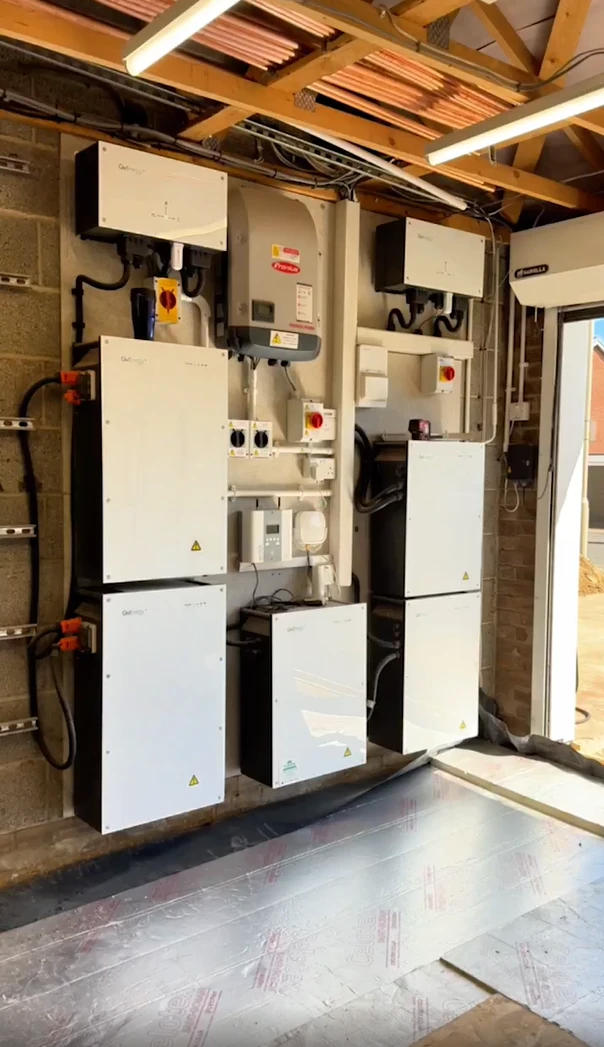

The household generates solar PV which is then stored in the home battery. That clean (and free) energy can then be discharged to power the ASHP, as and when required.
Researchers in Germany have already shown how this setup is possible, resulting in a more efficient heat pump and less power drawn from the grid.
Even without solar, a standalone battery storage system can also help power a heat pump more efficiently.
For instance, say you combine a standalone battery with a smart time of use tariff. You can charge your battery storage system when electricity is cheaper, then discharge this cheaper (and generally cleaner) electricity to charge your heat pump, as and when required.
Solar or no solar, a heat pump plus home battery combination is far more likely to be in your home in the coming years than a hydrogen boiler.
Ready to start your zero carbon journey?
If you’re ready to install a heat pump, you should consider combining it with a home battery.
Even if you’re not ready for a heat pump, battery storage can still help you cut:
- Energy bills by 85% per year
- Carbon emissions by 300kg per year
Click here to get started.